Canadian Laird Lentils (Large Green) Bulk Export Supply Program
Laird is commonly used in trade to describe large green lentils sourced from Canadian supply programs. This page is built for importers, bulk distributors, retail packers, and food manufacturers who need large-green lentils with dependable execution—clear grade expectations, practical sizing options, and shipment planning that matches destination requirements. We quote to your target specification, then confirm shipment results by lot before load-out so you can manage receiving risk and protect finished-product consistency.
This program is designed for buyers who treat large-green lentils as a quality-sensitive input, not a generic commodity line. Typical buyers include (1) importers building multi-origin supply, (2) retail packers who need stable appearance and sizing, (3) foodservice suppliers who prioritize integrity after cooking, and (4) manufacturers who need consistent sorting outcomes. If your customer specification is strict on defects, sizing, or appearance, tell us early—so the program is built around the receiving standard, not adjusted at the last minute.
Specifications & Grade Targets
Instead of listing one universal spec, we build a quote around your target parameters and confirm the shipped lot against those targets before loading.
Common grade variables (set at quote, confirmed by lot):
Moisture maximum (contract target)
Foreign material limit (contract target)
Purity target (contract target)
Defect limits (damaged, stained, broken, etc.)
Sizing / screens (when the end market requires a defined size profile)
We match packaging to how you receive, store, and repack:
Bags (export formats typically used in bulk trade)
Food-grade totes (for operations that prefer faster discharge and less handling)
At quotation stage, we confirm container-level details that matter for smooth receiving:
Palletized vs floor-loaded (where applicable)
Label format (language, lot coding, buyer references)
Warehouse identifiers (when required)
Any liner or handling requirements based on destination
If you’re a retail packer, include your labeling and lot-coding expectations in the RFQ—this prevents compliance rework at the end of execution.
Trade Terms & Shipment Flow
For large-green programs, the cleanest way to quote is to agree on (1) destination, (2) shipment window, and (3) execution plan (pack + container strategy). We can structure offers around trade terms such as FOB, CFR, or CIF when applicable, based on route and booking conditions.
To keep execution predictable, we align:
lot selection and grade targets
packaging / container plan
any inspection or testing requirements
final shipping window confirmation at booking
This approach reduces last-minute changes that typically create delays, claims, or mismatched landed cost.
Export Documentation & Destination Requirements
Documentation isn’t “one checklist for all countries.” We align the export set to your destination and buyer requirements. Typical documents include:
Commercial invoice
Packing list
Bill of lading
Destination-dependent additions can be supported where required/requested:
Phytosanitary certificate
Certificate of origin (if requested/required)
COA / lab testing (moisture, defects, FM, etc.)
Third-party inspection (upon request)
If your customer requires a specific certificate language, legalization steps, or additional data fields, include that in the RFQ so the paperwork is built into the execution plan from the beginning.
Applications & Performance Notes (Large Green)
Large green (Laird-type) lentils are often chosen when the buyer cares about appearance and integrity through handling and cooking—useful for retail packs, chilled meals, and foodservice applications where lentils must remain visually consistent. For many buyers, the real performance difference shows up in:
the size profile (screens)
the cleaned appearance (FM + visible defects)
uniformity in the pack (especially for retail)
If your product line is sensitive to appearance (retail shelf / premium positioning), request sizing and defect targets explicitly so lot selection and cleaning outcomes match the finished-product goal.
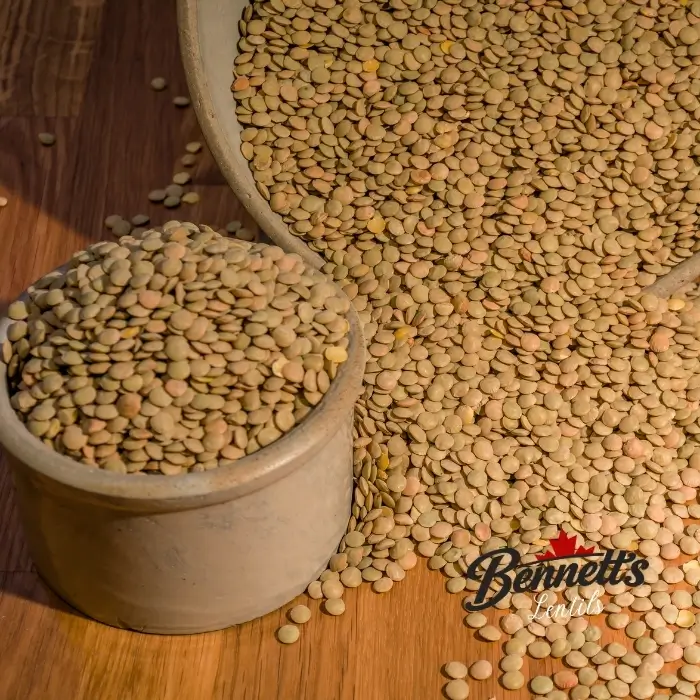
In trade language, “Laird” commonly refers to large green lentils. Buyers typically use this term when they want a green lentil with a large-seed profile and strong visual presentation. If you require a specific size profile, include screens in your RFQ.
Screen requirements depend on your market and whether you’re packing for retail, foodservice, or manufacturing. If your customer specification references a size profile, share it in the RFQ so the quote is built around that target and confirmed by lot before shipment.
Retail packers usually care most about (1) uniform appearance, (2) low foreign material, (3) tight defect tolerance, and (4) consistent size profile. If your label positioning is premium, ask for stricter defect and sizing targets to protect shelf consistency.
Laird generally refers to a large green class, while smaller green programs are built around a different size profile. If your end market is sensitive to size, specify the size class and screens; otherwise, you may receive a profile that doesn’t match your customer expectation.
No. Export pricing depends on grade targets, volume, packaging, destination, and trade terms. Send the RFQ details and we’ll return an offer aligned to your shipment window and receiving requirements.
Destination, trade term, volume, packaging, grade targets (including screens), and shipping window. With these six inputs, we can price without back-and-forth and avoid re-quoting due to missing specs.